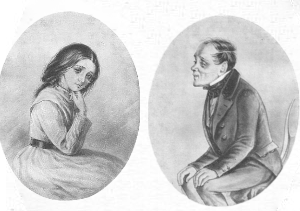
In his article “Little Boxes, Glocalization, and Networked Individualism”, Barry Wellman describes how social structures have been evolving following the development of technologies. In particular, the scientist demonstrates how social relations could be influenced by pervasive communication technologies or a lack of them like in the society of “little boxes” characterized by tight connections within each “box” and weak interaction between them. The novel Poor Folk written by Fyodor Dostoevsky depicts the correspondence of the “little boxes” society’s representatives, and therefore provides us with the opportunity to estimate the impact of epistolary communication on their relations.
It’s not so difficult to get a handle on the “little boxes”: just imagine our modern society and then remove all significant inventions made for last two centuries. Mid-nineteenth-century St Petersburg depicted in the Dostoevsky’s novel could serve as an example of the society of “little boxes”. In those days, citizens were transported by cabs or walked. They exchanged information by word of mouth or via letters. Despite a developed postal organization in the city, the majority of people couldn’t afford to use it.

Partly, due to the costliness of the post’s services, the rank-and-file functionary Makar Devushkin moves into a new apartment. The hero needs to settle near the house of the humble seamstress Varvara Dobroselova to maintain epistolary connection with her. In addition to disclosure of the rich inner worlds of the heroes, their correspondence helps readers to evaluate what impact on the social relations epistolary communication has.
The Devushkin’s first letter may tell us a lot about this impact. The letter is replete with compliments (“my angel”, “my beloved one”) and thorough description of emotions (“How happy I was last night—how immeasurably, how impossibly happy!”). These details demonstrate how greatly the character appreciates his connection with Varvara. Hardly can the letter be lumped in with the modern messages where even some words are shortened.
While someone could explain the thoroughness of descriptions by appealing to Makar’s feelings, I tend to believe that the means of communication also has a significant contribution. Indeed, as Makar writes, he has to ask the familiar woman Teresa for delivering letters from Makar’s communal flat to Varvara’s house. Although Teresa is kind and reliable, Makar doesn’t want to take advantage of her goodness and sends letters quite rarely. Therefore, to my mind, he includes as much information as possible.
Another important characteristic of their communication is references to the past letters. Devushkin often mentions facts from received messages throughout his writing (“But how is our good Thedora? …You write that she is now living with you…”). Consequently, he observes the whole picture of Varvara’s life and tries to be its part rather than pointlessly consumes information. To my mind, when people make so many efforts to maintain connection and their messages sincerely and precisely reflect their emotions, letters become a genuine means of interaction.

The way of communication and therefore some aspects of social relations have drastically changed in our modern world of “networked individualism”. This form of social arrangements is characterized, in a nutshell, by unfettered interconnection between single individuals. First and foremost, the maintenance of relationships with any person doesn’t require so monumental efforts nowadays. That’s why, the majority of people email or phone so many individuals that the amount of information they receive and send is colossal. On the other hand, the possession of many connections causes the devaluation of each of them. Indeed, we are not able to pay a lot of attention to every interlocutor.
To sum up, the Dostoevsky’s novel demonstrates that communicating via letters, members of the society of “little boxes” maintained much tighter connections although their number was finite. It’s consistent with the Wellman’s theory according to which “little boxes” made up tight-knit groups. Although modern technologies allow us to create a large number of links, they are less strong than those within a “little box”.
References
Barry Wellman, “Little Boxes, Glocalization, and Networked Individualism”, Berlin, Heidelberg, 2001
Fyodor Dostoevsky, Poor Folk, Translator: C. J. Hogarth;
 Tree octopus